Argyle, Texas occupies a unique position in the North Texas landscape. It is not a dense suburban grid. It is not a sea of production homes on 50-foot lots. It is a community defined by space — large acreage estates, luxury custom homes, and a small-town character that has drawn families from across the Metroplex for one primary reason: Argyle ISD, consistently ranked the number one school district in Denton County and among the best in the state.
With a median home price hovering around $660,000 and properties ranging from master-planned communities to 10, 20, and 30-plus acre custom estates, Argyle is a premium market — and a market where custom inground pools are a natural extension of the lifestyle. Denton County as a whole saw a 23% year-over-year increase in new pool permits in Q3 2025. Argyle, with its larger lots and luxury home stock, is a meaningful piece of that growth.
But pool excavation in Argyle, TX is not a one-size-fits-all scope. The two sides of Argyle — the acreage custom estate market and the newer master-planned communities like Harvest and Canyon Falls — present very different excavation contexts. This guide covers what homeowners and pool builders in Argyle need to know about the dig before the machine ever rolls through the gate.
Understanding Argyle means understanding its dual residential identity — because it directly affects how pool excavation projects are scoped and executed in this market.
The Acreage and Custom Estate Market
The legacy Argyle most people think of is large-lot country: one to thirty-plus acres, custom homes, horses on some properties, and a lifestyle centered on space and privacy. These lots give homeowners the room to build resort-style backyard environments — large freeform pools, detached spa structures, sunken outdoor living areas, full outdoor kitchens, and expansive decking. Pool excavation on Argyle's acreage properties often involves larger, more complex scopes than typical DFW suburban digs. Grading around natural terrain features, navigating established tree lines, and working with larger equipment on open lots are all part of the equation.
Master-Planned Communities — Harvest, Canyon Falls, and Beyond
Newer Argyle has evolved beyond the acreage-only identity. Communities like Harvest and Canyon Falls have brought modern master-planned living to Argyle, with organized neighborhoods, shared amenities, and homes from builders like Ashton Woods, Coventry Homes, Drees Custom Homes, and Highland Homes. These communities offer more standardized lots — typically 60 to 80 feet wide — with HOA architectural review processes that run parallel to Town of Argyle permitting requirements.
Pool excavation in Harvest and Canyon Falls follows a similar process to other master-planned communities in the DFW corridor: HOA approval first, Town permit second, dig third. The difference is that even within these master-planned sections, Argyle tends toward larger lots and more generous backyard space than comparable communities in Frisco or McKinney — which means pool designs tend to be more ambitious and excavation scopes tend to be larger.
Argyle sits in Denton County on the same Blackland Prairie clay formation that runs throughout the northern DFW corridor. Like the rest of North Texas, the dominant soil challenge for pool excavation in Argyle is expansive black clay — but the acreage side of the market adds terrain variables that don't exist in dense suburban settings.
Expansive Black Clay
The Blackland Prairie clay beneath Argyle's residential properties is highly expansive — absorbing moisture during wet seasons and contracting sharply during dry ones. This constant shrink-swell movement is the primary reason pool construction in Argyle requires proper foundation support, precision excavation, and correctly engineered backfill. In Argyle's clay soil, every phase of the excavation has to be executed with this movement in mind.
Terrain Variation on Acreage Properties
Unlike flat suburban lots, many Argyle acreage properties feature natural grade changes, drainage swales, established tree lines, and irregular terrain that affect how pool excavation is laid out and executed. A pool dig on a property with a natural slope requires careful elevation management to ensure the pool shell sits correctly and the surrounding grade drains properly. Operators who are used to flat suburban digs need a different skill set when working on Argyle's custom estate lots.
Established Root Systems
On older Argyle properties with mature oak and cedar trees, underground root systems can affect both the excavation path and the post-dig ground stability. A professional pool excavation crew in Argyle understands how to work around established root zones without compromising either the trees or the excavation quality.
Variable Fill in Newer Developments
In the recently developed phases of Harvest, Canyon Falls, and other master-planned communities in Argyle, the subsurface can include imported fill material from mass grading operations. This variable fill profile can behave differently from native Denton County clay, and experienced operators assess it before and during the dig.
Here's exactly what professional pool excavation in Argyle, TX looks like from the day equipment arrives to the final site handoff:
Step 1: Site Assessment and Equipment Selection
Argyle's diversity of lot types requires a more thorough pre-dig site assessment than most DFW markets. Access route, gate dimensions (on acreage properties, there may be no gate — or the access route may cross natural terrain), overhead obstructions, tree proximity, grade changes, and utility locations all need to be confirmed before mobilization. The right equipment for a flat master-planned lot and the right equipment for a sloped five-acre estate are not always the same machine.
Step 2: Utility Location
Call 811 to have public utilities marked before any excavation begins. On Argyle's acreage properties — especially those with private wells, septic systems, irrigation infrastructure, and private gas lines to outbuildings or horse facilities — the scope of private utility identification is more extensive than on a standard suburban lot. This step requires more attention and communication than in a typical DFW suburb. Don't skip it or rush it.
Step 3: Laser Layout and Elevation Verification
The pool footprint is staked and laser-checked to the engineer's plans. On Argyle acreage properties with natural grade, elevation verification requires additional care — the pool's relationship to the surrounding terrain determines how water drains, how the deck transitions, and how the shell behaves over time. Every elevation point is confirmed before the first shovel breaks ground.
Step 4: Excavation
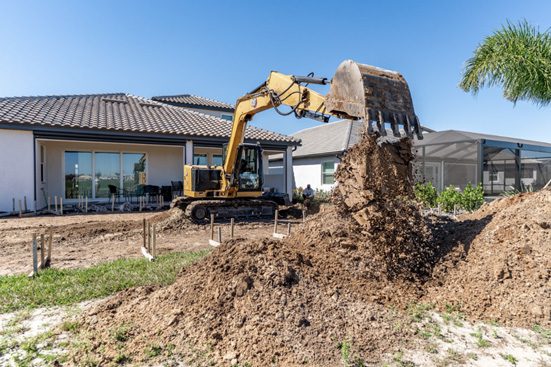
The dig begins. In Argyle's clay soil on standard lots, the process mirrors what we do across the DFW corridor. On acreage properties with natural terrain variation, the operator manages grade transitions, maintains clean wall cuts across varying elevations, and makes real-time assessments as conditions present themselves. This is where experience in Argyle's specific landscape — not just general DFW excavation experience — matters.
Step 5: Gravel Base Installation
A 6-inch compacted gravel base is installed following excavation. In Argyle's expansive clay, this is a structural requirement on every professional pool build — not an optional upgrade. It must be level, properly compacted, and ready to support the shell and plumbing alignment through the soil movement cycles that come with Denton County's climate.
Step 6: Site Cleanup and Handoff
Excavated material is hauled off-site the same day. The worksite is left graded, compacted, and ready for the gunite crew and plumbing trades to follow. On Argyle's larger properties, final grading around the pool footprint is especially important — the site needs to drain correctly before the next phase begins.
Permitting for pool construction in Argyle depends on where your property sits:
Within Argyle Town Limits
The Town of Argyle requires a building permit for pool construction. All development applications are reviewed by the Town's Development Review Committee, which includes the Director of Community Development, Town Engineer, and relevant municipal representatives. Your pool builder handles permit applications, but understanding the review process and its timeline is important for project scheduling.
In Unincorporated Denton County (Outside Town Limits)
Some Argyle-area properties — particularly larger acreage tracts — fall outside the Town of Argyle limits but within unincorporated Denton County. In these cases, a Denton County Development Permit is required from the Denton County Development Services Department before excavation begins. Any development activity — including grading, filling, and excavation — requires this permit in unincorporated county land.
Master-Planned Communities (Harvest, Canyon Falls)
In Argyle's master-planned communities, HOA architectural review approval must be obtained before Town or County permits are issued. The HOA review process adds two to six weeks to the pre-dig timeline. Starting this process early — well before the intended dig date — is essential for staying on schedule.
A professional pool excavation contractor in Argyle knows which permitting authority applies to your specific address and coordinates accordingly.
Pool excavation pricing in Argyle is consistent with the broader North DFW corridor market, with some upward adjustment for the complexity of larger-lot and custom estate projects:
Standard pool excavation (no gravel base):
$4,500 – $8,500
Pool excavation with 6-inch compacted gravel base:
$6,000 – $10,500
Complex excavation — spa, beach entry, sunken features, multiple custom elements:
$8,000 – $14,000+
Large acreage estate pools with terrain grading, extended feature scope:
$10,000 – $18,000+
Rock or unexpected buried material:
Cost-plus — add $2,000 – $10,000+ depending on volume
Argyle's premium market context means pool builds commonly run $75,000 to $250,000 or more for the luxury custom estate segment. Within that budget, excavation represents 5 to 15 percent of the total cost — and it is the phase that determines the structural integrity and long-term performance of everything above it.
In Argyle's expansive Denton County clay soil, helical pier installation is frequently specified by engineers for pool construction — particularly in the established sections of town with heavy native clay profiles. The same shrink-swell movement that affects pool construction across DFW is present beneath Argyle's residential properties, and the engineering response is the same: anchor the pool shell below the active moisture zone with torque-verified helical piers.
On Argyle's acreage properties, the pier scope may differ from a standard master-planned community dig — lot-specific soil reports and larger pool designs sometimes call for more piers, deeper installations, or different pier placement patterns. Pacesetter Excavation handles both pool excavation and helical pier installation across Argyle and Denton County, keeping the foundation work in one coordinated scope.
1. On acreage properties, know your private utility locations before anything else
Argyle's custom estate lots often have private wells, septic systems, irrigation systems, and gas lines to outbuildings that won't be marked by 811. A thorough private utility audit — before the quote is even finalized — protects your property and keeps the excavation on schedule.
2. Confirm your permitting jurisdiction
Are you inside Argyle Town limits or in unincorporated Denton County? This determines which permitting authority applies to your pool build. Your pool builder and excavation contractor should both know the answer before the first permit application goes in.
3. Start HOA approval early if you're in Harvest or Canyon Falls
In Argyle's master-planned communities, HOA architectural review runs before Town permitting. Starting this process in fall or winter protects your spring build window in a market where reputable pool builders are booked months in advance.
4. Plan access for larger equipment on acreage lots
On large Argyle properties, the excavation equipment access route may cross natural terrain rather than a standard paved side yard. Confirm the access path, identify any drainage crossings or soft ground sections along the route, and make sure your excavation contractor has assessed it before mobilizing.
5. Budget for natural terrain grading around the pool
On Argyle's sloped or contoured acreage lots, the final grade around the pool footprint is more complex than on a flat suburban lot. This work is part of what ensures the site drains correctly and the finished pool environment looks intentional rather than improvised. Confirm it's included in your excavation scope.
Pacesetter Excavation serves Argyle and the entire Denton County growth corridor — including Flower Mound, Lantana, Northlake, and the surrounding northwest DFW market. We bring the same professional standard to every Argyle dig that we bring across the Metroplex: laser-checked elevations, properly installed gravel base, same-day haul-off, clean site handoff, and itemized quotes with no surprises.
Whether you're building a resort-style pool on a two-acre custom estate or digging a pool and spa in Harvest or Canyon Falls, we understand the variables that make pool excavation in Argyle different from a standard suburban dig — and we come prepared for them.
We serve the Greater DFW area including Argyle, Flower Mound, Southlake, Keller, Frisco, Prosper, McKinney, Celina, and surrounding North Texas communities.