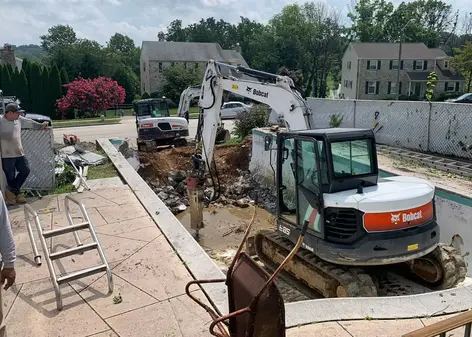
Flower Mound, Texas has built one of the most consistent reputations in the Dallas–Fort Worth area over the past two decades — a master-planned community feel with genuine space, top-rated schools, and a lifestyle centered on outdoor living. Situated in southern Denton County between Lewisville Lake to the north and the DFW Airport corridor to the east, Flower Mound attracts families who want the Metroplex's amenities without the density of closer-in suburbs.
With a population exceeding 85,000 and a housing stock that skews toward larger lots, custom homes, and established master-planned communities, Flower Mound has one of the most active residential pool markets in the DFW Metroplex. Pool builders working here book out months in advance. And every one of those pool builds starts with an excavation.
Pool excavation in Flower Mound, TX comes with specific challenges — soil conditions that shift across the city, a HOA landscape that rivals Prosper and Frisco in complexity, and a premium residential market where the standard of workmanship on every phase of a pool project matters. This guide covers everything homeowners and pool builders in Flower Mound need to know before the dig begins.
Flower Mound is not one homogeneous community. It spans a wide range of neighborhood types — from established golf course communities to newer master-planned developments — and that diversity affects how pool excavation is scoped and executed across different parts of the city.
Established Neighborhoods — Wellington, Bridlewood, Tour 18, and Canyon Falls
Flower Mound's signature established communities are known for large custom homes, mature tree canopies, and well-developed infrastructure. Wellington, built around a country club and golf course, features luxury homes in the $700K to $2M+ range. Bridlewood offers equestrian-friendly properties alongside standard residential lots. Tour 18 is a golf community with strong custom home stock. Canyon Falls straddles the Flower Mound and Argyle border and attracts families seeking newer construction with premium amenities.
Pool excavation in these established neighborhoods requires careful navigation — mature trees and root systems, narrow side-yard access points, extensive irrigation infrastructure, and owners who expect the crew to treat their property with the same care as every other premium trade on the job.
Newer Development Corridors
Flower Mound's western and northern edges have seen continued residential development over the past decade — communities with newer infrastructure, recently graded sites, and a more variable subsurface profile from mass grading operations. These areas tend to have larger lots relative to the broader DFW market and attract homeowners planning full resort-style backyard builds.
Lakeside and Waterfront Properties
Flower Mound's proximity to Grapevine Lake, Lewisville Lake, and several community water features creates a segment of waterfront and lake-adjacent properties that present unique considerations for pool excavation — elevated water table potential in certain areas, drainage management complexity, and premium backyard scopes that make the most of the water views.
Flower Mound sits at the intersection of Denton County's Blackland Prairie clay and the eastern edge of the Fort Worth Prairie — a transitional zone where soil conditions can vary more than in other DFW suburbs.
Expansive Black Clay
Like the rest of northern DFW, Flower Mound's dominant soil type is expansive black clay — the same Blackland Prairie formation that runs through Collin and Denton counties. This soil swells significantly when wet and contracts during dry seasons, creating the constant ground movement that requires proper foundation support, precision excavation, and correctly engineered backfill on every pool build.
Variable Soil Profiles
Flower Mound's position between the prairie and the Cross Timbers geological region means soil composition transitions across the city. In some areas, the clay profile is dense and uniform. In others — particularly in western neighborhoods toward the Argyle border — the subsurface can include sandy loam transitions, variable fill from residential development, and occasional rock encounters. An experienced pool excavation contractor in Flower Mound assesses each site individually rather than assuming uniform conditions across the city.
Rock Potential
Flower Mound is less rock-prone than neighboring Southlake to the southeast, but rock encounters are not unheard of — particularly in elevated terrain sections and in properties adjacent to Grapevine Lake's geological features. Any pool excavation contractor operating in this corridor should have hydraulic rock hammer capability staged and ready, not left back at the shop.
Drainage Considerations
Flower Mound's rolling terrain and proximity to multiple lake systems means drainage management is a more active consideration than in flat suburban markets. Properly graded pool excavation — with drainage accounted for in the final site grade — protects the pool shell from hydrostatic pressure and the surrounding yard from pooling after rain events.
Flower Mound is HOA country. The city's master-planned communities — Wellington, Bridlewood, Tour 18, Canyon Falls, and dozens of others — all maintain active HOA architectural review committees with specific covenants governing pool construction, equipment placement, fencing, deck materials, and backyard modifications.
In most Flower Mound master-planned communities, HOA approval must be obtained before the city issues pool building permits. This runs in sequence, not in parallel, and adds meaningful lead time to your project schedule.
What Flower Mound's HOA approval process typically requires:
Flower Mound Town Permitting
The Town of Flower Mound requires a building permit for all inground pool and spa construction. Permit applications are handled through the town's development services department. Permit fees in Flower Mound typically run $500 to $1,200 depending on pool scope and features.
Pool builders working regularly in Flower Mound understand the HOA layering in each community and build this timeline into their project schedules. Homeowners planning to break ground in spring should begin HOA approval in November or December at the latest.
Here's what professional pool excavation in Flower Mound looks like from equipment arrival to site handoff:
Step 1: Site Assessment and Equipment Selection
Flower Mound's diversity of lot types and neighborhood contexts means site assessment matters here more than in uniform suburban markets. Access route, gate dimensions, tree canopy clearances, root zone proximity, grade changes, and utility locations all need to be confirmed before mobilization. In established Flower Mound communities with mature landscaping, access planning can be more involved than on a standard flat suburban lot.
Step 2: Utility Marking
Call 811 before any excavation begins. Private utilities — Flower Mound properties often have extensive irrigation systems, gas lines to outdoor features, and low-voltage landscape lighting — need to be identified separately by the homeowner or builder. In waterfront-adjacent properties, be aware of drainage infrastructure that may not be immediately visible.
Step 3: Laser Layout and Elevation Verification
The pool footprint is staked and laser-checked to the engineer's plans. Every elevation point is confirmed before excavation begins. In Flower Mound's rolling terrain sections, elevation management requires extra attention — the pool's relationship to the surrounding grade determines drainage behavior and long-term site performance.
Step 4: Excavation
The dig begins. In Flower Mound's clay-dominant soil, the machine cuts through dense material that requires skilled, experienced operation. Variable soil transitions are handled in real time. Rock encounters, if they arise, are addressed with the appropriate equipment. A professional crew communicates clearly and keeps the project moving regardless of what the ground presents.
Step 5: Gravel Base Installation
A 6-inch compacted gravel base is installed following excavation — a structural requirement in Flower Mound's expansive clay soil, not an optional upgrade. Level, properly compacted, and continuous across the entire pool footprint.
Step 6: Site Cleanup and Handoff
Excavated material is hauled off-site the same day. The worksite is left graded, compacted, and clean — ready for the gunite crew, plumbers, and steel installers who follow. In Flower Mound's premium residential environment, the site handoff standard is high.
For a standard residential pool in Flower Mound on a typical residential lot with standard access:
Standard pool and spa: 1 to 1.5 days
Complex multi-feature pool: 1.5 to 2.5 days
Large custom scope with terrain grading: 2 to 3 days
Rock encounter add-on: 1 to 2+ additional days depending on volume
A professional pool excavation contractor in Flower Mound gives you a realistic timeline based on your specific site — and communicates transparently if field conditions change that timeline.
Pool excavation pricing in Flower Mound tracks with the broader North DFW and Denton County market:
Standard pool excavation (no gravel base):
$4,500 – $8,500
Pool excavation with 6-inch compacted gravel base:
$6,000 – $10,500
Complex excavation — spa, beach entry, sunken features:
$8,000 – $14,000+
Rock encounter (if applicable):
Cost-plus — add $2,000 – $10,000+
Flower Mound's pool market spans a wide range — from solid $80,000 to $120,000 family pool builds to $200,000+ resort-style transformations in Wellington and Bridlewood. In every case, excavation represents the structural foundation that every phase of the build depends on.
In Flower Mound's expansive Denton County clay soil, helical pier installation is frequently specified by engineers for pool construction — particularly in the city's heavier clay zones. The shrink-swell movement that affects pool construction across DFW is present throughout Flower Mound, and engineers in this market regularly call for helical piers to anchor the pool shell below the active moisture zone.
Pacesetter Excavation handles both pool excavation and helical pier installation across Flower Mound and the surrounding Denton County corridor, keeping the foundation work in one coordinated scope.
1. Start HOA approval early — not when you're ready to dig
In Flower Mound's master-planned communities, HOA review runs before town permitting. Start in fall or early winter for a spring dig date. The two-to-six-week review window is real — don't discover it when you're already on the builder's schedule.
2. Know your terrain
Flower Mound's rolling topography means your backyard may not be flat. How the pool sits relative to the surrounding grade affects drainage, the deck transition, and the overall site performance. Make sure your pool builder and excavation contractor have discussed final grading as part of the scope.
3. Protect established landscaping
In Wellington, Bridlewood, and Flower Mound's older neighborhoods, mature trees and established landscaping are part of what makes properties valuable. Confirm access routes and root zone protection measures with your excavation contractor before dig day.
4. Identify every private utility
Flower Mound's premium residential lots frequently have extensive irrigation infrastructure. Walk the yard, document what you know, and involve your irrigation contractor in pre-dig utility identification.
5. Ask about rock handling upfront
Flower Mound is not Southlake — rock is not a guarantee here. But it's possible in certain parts of the city. Any pool excavation contractor worth hiring in this market has a clear, written policy on how rock is handled if encountered.
Pacesetter Excavation serves Flower Mound and the entire southern Denton County corridor — including Argyle, Lantana, Northlake, Southlake, Keller, and surrounding communities. We bring the same professional standard to every Flower Mound dig: laser-checked elevations, properly installed gravel base, same-day haul-off, clean site handoff, and itemized quotes with no vague language and no surprise charges.
Pool builders and homeowners in Flower Mound count on Pacesetter because we show up when we say, dig to spec, and communicate clearly from quote to completion. Whether you're building in Wellington, Bridlewood, Canyon Falls, or anywhere else in Flower Mound's diverse residential landscape, we come prepared for what your site actually presents.