Trophy Club, Texas is one of the most distinctive communities in the entire Dallas–Fort Worth area. Built around the legendary Byron Nelson Golf Course and Trophy Club Country Club, this master-planned community sits at the intersection of Tarrant and Denton counties — bordered by Southlake to the east, Westlake to the southeast, and Roanoke to the north. It is a community defined by intentional design: manicured streets, mature tree lines, golf course terrain, and a lifestyle built around outdoor living.
With a population of approximately 13,000 residents and a housing market ranging from the high $500Ks to well above $1 million in golf course-adjacent properties, Trophy Club attracts families and executives who prioritize quality, community, and the kind of environment where a custom inground pool is not a luxury add-on but a natural centerpiece of the backyard. Pool construction here is consistently active — and pool excavation in Trophy Club comes with specific challenges driven by the city's geography, geology, and community structure.
This guide covers everything Trophy Club homeowners and pool builders need to know before breaking ground: what makes the soil and terrain here unique, what the excavation process looks like, what it costs, how permitting and HOA approvals work, and what to look for in a pool excavation contractor in this market.
Trophy Club is not a standard flat suburban market. The city's layout follows the natural contours of the land around Byron Nelson Golf Course and Trophy Club Country Club — rolling terrain, elevation changes, mature tree canopies, and golf course-adjacent properties that sit on elevated or contoured lots. These characteristics affect pool excavation in ways that a crew used to flat production-home lots won't anticipate.
Golf Course Terrain and Natural Grade
Many of Trophy Club's most desirable properties sit adjacent to or overlooking the golf course. These lots often feature natural grade changes — slopes, terraced landscaping, and contoured backyards that have been shaped over decades around the golf course's terrain. Pool excavation on these lots requires careful elevation management to ensure the pool shell sits correctly relative to the surrounding grade, that drainage runs correctly away from the structure, and that the finished backyard environment integrates with the natural terrain rather than fighting it.
Rock Risk — Trophy Club's Geological Reality
Trophy Club sits at the eastern edge of the Fort Worth Prairie, in geological proximity to the limestone formations that make Southlake one of the most rock-prone pool markets in DFW. Pool excavation in Trophy Club encounters rock more frequently than in purely clay-dominant suburbs like Frisco or McKinney. Limestone and caliche can be found at varying depths across the city — sometimes immediately below a surface clay layer, sometimes several feet down.
Rock in Trophy Club is not a guarantee on every dig — but it is common enough that any professional pool excavation contractor serving this market needs to have hydraulic rock hammer capability staged and ready, a clear written policy for how rock is priced when encountered, and the communication process to notify the homeowner or builder promptly when conditions change mid-dig.
Expansive Clay Soil
Below the rock risk, Trophy Club's soil profile includes the same expansive Blackland Prairie clay that affects pool construction throughout the DFW Metroplex. This clay expands with moisture and contracts in dry conditions — the shrink-swell behavior that makes proper gravel base installation, helical pier support, and precision excavation non-negotiable elements of a durable pool build in North Texas.
Mature Landscaping and Established Access
Trophy Club was developed over decades — the earliest sections date to the 1980s and early 1990s. Many properties feature mature trees, established irrigation systems, and backyard environments that reflect years of investment. Pool excavation in these properties requires operators who know how to work within established residential environments — protecting mature trees, navigating root zones, and executing a precision dig without treating a carefully maintained backyard like a construction staging area.
Trophy Club's residential landscape spans several distinct areas, each with its own character and excavation context:
Golf Course Properties — Trophy Club Country Club and Byron Nelson Frontage
The most prestigious addresses in Trophy Club sit directly on or adjacent to the golf course. These properties often feature elevated terrain, premium custom homes, and backyard environments where pool design is integrated with golf course views. Pool excavation on these lots requires terrain-aware grading, careful management of the pool's relationship to the golf course boundary, and operators who understand how to execute complex scopes on contoured sites. Prices in these sections commonly run $900K to $1.5M+.
Indian Creek and Lakeview Sections
Indian Creek is one of Trophy Club's earliest and most established residential sections — homes from the late 1980s and 1990s on larger lots with mature tree canopies. Pool excavation here involves older landscape infrastructure, established root systems, and the kind of backyard complexity that develops over 30+ years of homeownership. Lakeview properties sit near the community's lake features and may carry elevated water table considerations that affect excavation drainage management.
Newer Sections — Trophy Club East and Recent Phases
Trophy Club's newer residential phases offer more recently constructed homes on lots with newer infrastructure and less established landscaping. Pool excavation in these sections is more straightforward from an access and landscape standpoint — but the same soil and rock awareness applies regardless of neighborhood age.
The Highlands and Trophy Club Proper
Homes in the $500K to $750K range across Trophy Club's core residential grid. Standard master-planned community excavation applies here, with full HOA review process and the same clay/rock profile that runs throughout the city.
Here's exactly what professional pool excavation in Trophy Club, TX looks like from equipment arrival to site handoff:
Step 1: Site Assessment and Equipment Confirmation
Trophy Club's terrain variation and mature landscaping make pre-dig site assessment more important here than in flat suburban markets. Access route, gate dimensions, overhead clearances, tree proximity, grade changes, rock contingency equipment confirmation, and utility identification all need to be confirmed before mobilization. A crew that shows up to a contoured Trophy Club golf course lot without having assessed the site and confirmed their equipment setup has already created a problem.
Step 2: Utility Marking
Call 811 before any excavation begins. In Trophy Club's older sections, private utilities — irrigation systems expanded and modified over decades, gas lines, low-voltage landscape lighting — can be more extensive than 811 marking covers. Comprehensive private utility identification before dig day protects your property and your project schedule.
Step 3: Laser Layout and Elevation Verification
The pool footprint is staked and laser-checked to the engineer's plans. In Trophy Club's terrain-variable lots, elevation management is especially important — the pool's relationship to the surrounding grade determines drainage behavior, deck transition design, and how the finished backyard environment reads from inside the home. Every elevation point is confirmed before the machine starts moving.
Step 4: Excavation — Clay and Rock
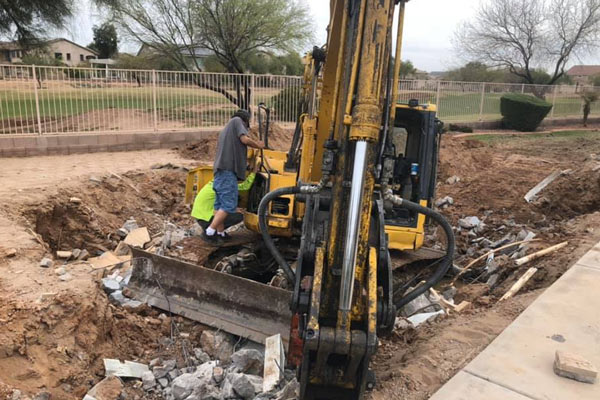
The dig begins. In Trophy Club's clay zones, the machine works through dense, moisture-sensitive material that rewards skilled, experienced operation. When rock is encountered — and in Trophy Club it happens with meaningful frequency — the operator switches to the rock hammer, communicates the change in scope immediately, and keeps the project moving within a clearly understood cost framework. This is where the difference between an experienced Trophy Club crew and a crew that hasn't worked this geology shows up in real time.
Step 5: Gravel Base Installation
A 6-inch compacted gravel base is installed following excavation. In Trophy Club's clay and mixed soil conditions, this base is the structural layer that the pool shell depends on. Level, properly compacted, covering the entire pool footprint including spa and beach entry areas — no shortcuts.
Step 6: Site Cleanup and Handoff
Excavated material — including rock debris if applicable — is hauled off the same day. The site is left graded, compacted, and clean. In Trophy Club's premium residential environment, the cleanup standard is high. A professionally executed pool excavation leaves the site in better condition than most crews leave it — and that's what Pacesetter delivers.
The Town of Trophy Club requires a building permit for all inground pool and spa construction. Permits must be issued before any excavation begins. Trophy Club's permit process is handled through the Town's Community Development department.
Key permitting notes for Trophy Club:
HOA Approval
Trophy Club homeowners in HOA-governed sections — the majority of the city — must obtain architectural review approval from their HOA before the Town of Trophy Club issues building permits. The HOA review period typically runs two to four weeks. Starting this process well ahead of your intended dig date is essential for protecting your build schedule, especially if you're targeting a spring excavation window.
Pool excavation pricing in Trophy Club reflects the city's market position and the geological variables in play:
Standard pool excavation (no gravel base):
$4,500 – $9,000
Pool excavation with 6-inch compacted gravel base:
$6,000 – $11,000
Complex excavation — spa, beach entry, custom terrain grading:
$8,500 – $15,000+
Rock encountered during excavation:
Cost-plus — add $2,000 – $10,000+ depending on volume and density
Trophy Club's pool market spans from solid family builds in the $65,000 to $110,000 range up to resort-style golf course property transformations exceeding $250,000. At every level, excavation is the structural foundation of the investment — and rock contingency budgeting is more important here than in most DFW markets. Build a rock contingency into your budget before the first permit is pulled.
In Trophy Club's clay-dominant zones, helical pier installation is frequently specified by engineers for pool construction — particularly in properties with heavier native clay profiles. The expansive clay soil present throughout Tarrant County exerts the same structural forces on pool shells in Trophy Club that it does across the DFW Metroplex, and the engineering response is the same: anchor the pool below the active moisture zone with torque-verified helical piers.
On golf course and contoured lots where soil profiles may be more variable, an engineer's soil assessment is especially valuable before finalizing the foundation design. Pacesetter Excavation handles both pool excavation and helical pier installation in Trophy Club and the surrounding Tarrant/Denton County corridor.
1. Budget for rock before you sign your pool contract
Trophy Club's rock probability is real. Build a contingency into your total pool budget before the first permit is pulled — not after the excavation crew calls mid-dig to report limestone. Know the number, understand the cost framework, and don't be blindsided.
2. Confirm rock hammer equipment capability
Ask your excavation contractor directly: do you have hydraulic rock hammer capability available for this job? In Trophy Club, the answer should be yes and it should be available on the day of the dig — not something they need to rent after rock is encountered.
3. Start HOA approval well before your intended dig date
Trophy Club's HOA review runs before Town permitting. Two to four weeks is standard — longer if your submission is incomplete or requires revision. Start this process early and don't book the excavation crew until the approval letter is confirmed.
4. Account for terrain in your drainage plan
On Trophy Club's contoured lots, how water drains around the pool after the excavation and construction is complete matters as much as the dig itself. Confirm with your pool builder and excavation contractor that final grading accounts for positive drainage away from the shell and the surrounding structures.
5. Protect mature trees and irrigation
In Trophy Club's older sections, mature trees and established irrigation systems represent significant property investment. Know where your irrigation lines run, identify root protection zones for mature trees near the excavation footprint, and confirm these with your excavation contractor before dig day.
Pacesetter Excavation serves Trophy Club and the entire northeast Tarrant County corridor — including Southlake, Keller, Westlake, Colleyville, Grapevine, Roanoke, and surrounding North Texas communities. We bring the same professional standard to every Trophy Club dig: laser-checked elevations, hydraulic rock hammer capability staged and confirmed, properly installed 6-inch compacted gravel base, same-day material removal, clean site handoff, and itemized quotes with transparent rock handling policy in writing.
Trophy Club is a community where every phase of a pool build needs to reflect the quality of the environment it's going into. That starts with the excavation — and that's the standard Pacesetter was built to deliver.